
Easter Swiss Rolls with Cream Cheese Filling
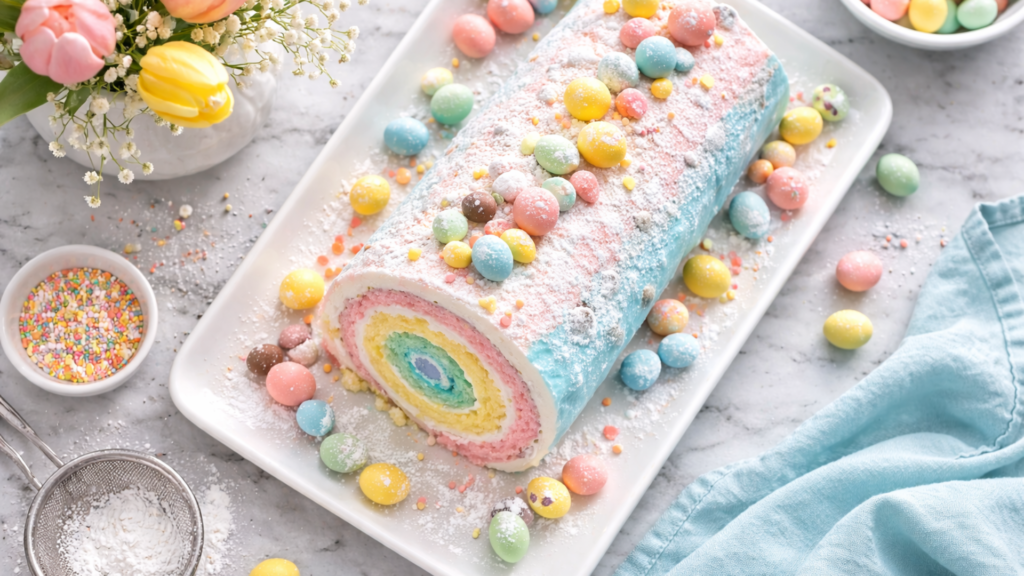
There is something magical about a rolled cake.
It feels like a little secret, doesn’t it? A flat sheet of cake, humble and unassuming, goes into the oven. It comes out golden and fragrant. And then, with a gentle flip, a soft dusting of powdered sugar, and a careful roll, it transforms into something entirely different. Something spiral-shaped and beautiful. Something that holds a surprise inside.
That is how I feel about spring, too.
Spring arrives quietly. One morning you wake up, and the light coming through the kitchen window is softer. The air smells different—fresher, greener. The world unrolls itself, slowly, revealing color after color after a long, quiet winter. Pink blossoms. Yellow tulips. Green grass that seems to appear overnight.
I wanted to capture that feeling in a cake.
These Easter Swiss Rolls are my love letter to spring colors. Not to any specific holiday, but to the season itself—the pastels, the softness, the joy of watching something unfold. I took a simple, fluffy cake batter and divided it into three bowls. A drop of pink here. A touch of yellow there. A whisper of green. Then I let them swirl back together, just like spring does, blending and blending until you cannot tell where one color ends and another begins.
The filling had to be just right. Not too heavy, because spring is light. Cream cheese whipped with heavy cream until it is cloud-soft, sweetened just a little, with a dash of vanilla to warm it up. And then the surprise inside—crushed Easter candies, little nuggets of chocolate and crunch hiding in the cream, waiting to be discovered in every slice.
When I unrolled the cooled cake, spread that fluffy filling, and scattered the candies, my heart did a little skip. The colors against the white cream. The promise of that first bite. I rolled it back up, tight and neat, and dusted it with powdered sugar like a fresh dusting of spring snow.
The first slice revealed the spiral. Pink and yellow and green, wrapped around a creamy center dotted with candy. It looked exactly like spring feels.
Here is why these Easter Swiss Rolls are about to become your favorite spring baking project:
~~ Fluffy, Cloud Like Cake: Egg whites make this cake impossibly light and tender. It rolls without cracking every single time.
~~ Stunning Marbled Colors: No two cakes look alike! Swirl your favorite pastels together for a unique, beautiful result.
~~ Dreamy Cream Cheese Filling: Lightly sweet, perfectly tangy, and whipped to silky perfection.
~~ A Crunchy Surprise Inside: Crushed Easter candies hidden in the filling add texture and a little pop of chocolate in every bite.e table.


The Secret to a Perfect, Crack Free Swiss Roll
Swiss rolls have a reputation for being tricky. But here is the truth: with the right technique, they are actually quite forgiving. Let me walk you through the science behind each step so you can roll with confidence.
Why Egg Whites Only?
This cake is unusual, it uses only egg whites, no yolks. Here is why that matters:
- Color: Without yolks, the cake stays pristine and pale, which allows your pastel food colors to pop brilliantly. No yellow tint competing with your pink and green!
- Texture: Egg whites create a lighter, airier structure. The cake becomes soft and pliable, which is exactly what you need for rolling without cracking.
- Flavor: The absence of yolks keeps the flavor clean and neutral, letting the cream cheese filling and candies shine.
Soft Peaks and Gentle Folding
The texture of your beaten egg whites determines the texture of your cake. Here is what to look for:
Step 1: Foamy Beginnings
Start beating the egg whites, lemon juice, and salt. At first, they will be opaque and bubbly, like a bubble bath. This is the foamy stage.
Step 2: Soft Peaks
As you gradually add the sugar and keep beating, the bubbles will become smaller and tighter. The mixture will turn white and glossy. When you lift the beater, the peak that forms should flop over softly and hold its shape loosely. This is a soft peak, the perfect stopping point. If you go too far, the whites become stiff and dry, which can make the cake tough.
Step 3: Folding in the Flour
This is where gentle hands matter most. Sprinkle the sifted cake flour over the beaten egg whites. Use a rubber spatula to cut down through the center of the mixture, scrape along the bottom of the bowl, and bring it back up. Rotate the bowl as you go. Repeat until no streaks of flour remain. The goal is to incorporate the flour without deflating all those beautiful air bubbles you just created.
The Marble Swirl Technique
How do you get those gorgeous, swirled colors without them turning muddy?
- Divide your batter evenly into three bowls.
- Add a different gel food color to each bowl. Use a toothpick or the tip of a knife to add the color , a tiny bit goes a long way with gel!
- Gently fold the color into each bowl separately until just combined. You want uniform color in each bowl, but do not overmix.
- Drop spoonfuls of each color randomly into the prepared pan. Alternate colors, overlap them, create a pattern.
- Here is the key: Use a knife or skewer to gently swirl the colors together. Drag it through the batter in a figure eight pattern or in one direction. Stop after just a few swirls. If you over-swirl, the colors will blend into a single muddy brown. You want distinct ribbons of color, not a uniform mix.
The Hot Roll: Why We Roll Twice
This is the most important trick in the Swiss roll book.
- The First Roll (Hot): As soon as the cake comes out of the oven, you flip it onto a clean parchment sheet, peel off the baked parchment, and roll it up while it is still hot. Why? Because hot cake is flexible. Cooling it in a rolled position “trains” the cake to remember this shape. It prevents cracks when you fill and re-roll it later.
- Cooling Completely: Let the cake cool completely while rolled. If you unroll it while still warm, it might tear or stick.
- The Second Roll (Filled): Once cool, the cake will unroll easily and lie flat, ready for filling. When you roll it back up, it will cooperate beautifully because it already knows how.
The Whip: Cream Cheese and Cream
This filling is lighter than a traditional cream cheese frosting because we are using whipped cream.
- Softened Cream Cheese is Non-Negotiable: Cold cream cheese will not whip smoothly with the cream. You will end up with lumps. Leave it on the counter for at least an hour before starting.
- Whip to Stiff Peaks: Beat the cream cheese, cream, sugar, and vanilla together until medium-stiff peaks form. The mixture should hold its shape firmly when you lift the beater. This structure is what will hold the crushed candies in place and keep your roll from oozing when sliced.
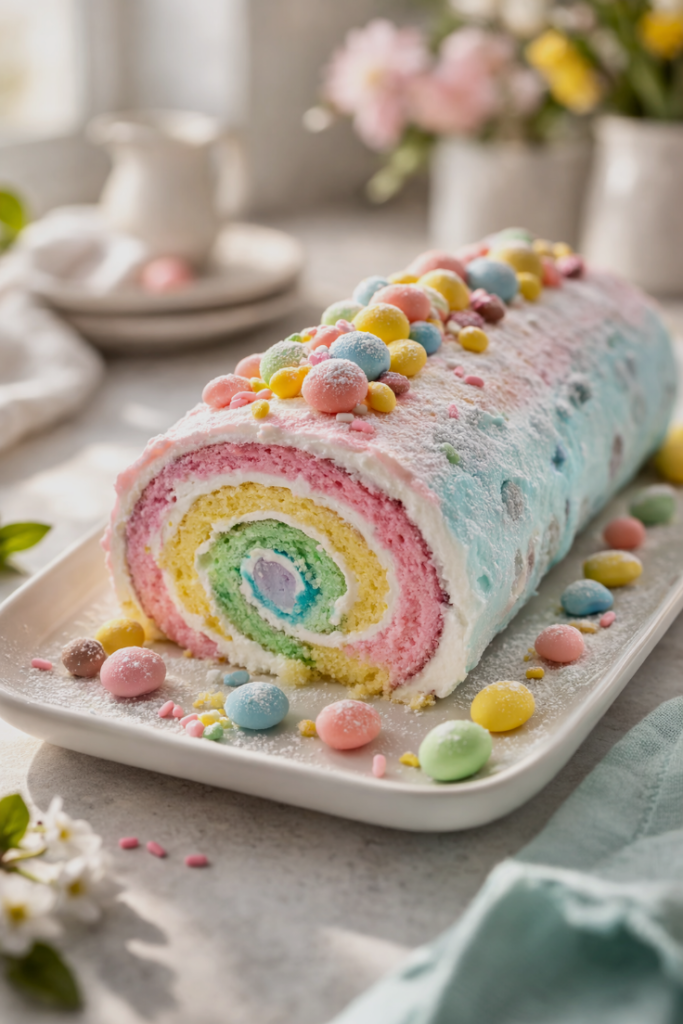
Let’s Bake! Your Step-by-Step Guide to Easter Swiss Rolls
Ingredients:
Here is everything you need. I’ve provided both cups and grams for your convenience.
For the Cake:
- 6 large egg whites (about ¾ cup / 180g)
- 1 teaspoon lemon juice
- ¼ teaspoon salt
- ¼ cup (50g) granulated sugar
- ½ cup + 1 tablespoon (70g) sifted cake flour (spooned and leveled, then sifted)
- Gel food coloring in your favorite Easter colors (pink, yellow, green, lavender)
- Powdered sugar, for dusting
For the Filling:
- 4 oz (113g) cream cheese, softened to room temperature
- ¾ cup (180ml) heavy cream
- 1 tablespoon (12g) granulated sugar
- Dash of vanilla extract
- ½ cup crushed Easter candies (like chocolate eggs), plus more for decorating
A Step-by-Step Instructions:
Step 1: Preheat and Prep Your Pan
Preheat your oven to 350°F (175°C). Spray a 10×15-inch jelly roll pan with nonstick spray. Line it with parchment paper, leaving a little overhang on the long sides to help you lift the cake out later. Spray the parchment lightly as well.
Step 2: Beat the Egg Whites
In a large, clean mixing bowl, combine the 6 egg whites, 1 teaspoon lemon juice, and ¼ teaspoon salt. Using a stand mixer with the whisk attachment or a hand mixer, beat on medium high speed until foamy. With the mixer running, gradually add the ¼ cup (50g) sugar. Continue beating until soft peaks form. The peaks should flop over softly when you lift the beater.
Step 3: Fold in the Flour
Sift the ½ cup + 1 tablespoon (70g) cake flour again, directly over the beaten egg whites. Using a rubber spatula, gently fold until just combined. Be careful not to deflate the batter, stop as soon as no streaks of flour remain.
Step 4: Divide and Color
Divide the batter evenly into three small bowls. Add a different gel food coloring to each bowl, a tiny amount on the tip of a toothpick is plenty. Gently fold the color into each batter until uniform.
Step 5: Swirl and Spread
Drop spoonfuls of each colored batter randomly into the prepared pan, alternating colors. Once all the batter is in the pan, use a knife or skewer to gently swirl the colors together. Do not over-swirl—you want distinct ribbons of color. Use an offset spatula to gently spread the batter into an even layer.
Step 6: Bake
Bake for 12 minutes, until the cake springs back when lightly touched. The edges will be lightly golden.
Step 7: The First Roll
While the cake bakes, lay out a clean kitchen towel or another sheet of parchment paper on your counter. Dust it generously with powdered sugar. As soon as the cake comes out of the oven, immediately flip it onto the prepared towel or parchment. Carefully peel off the baked parchment paper. Starting from a short end, gently roll the cake up with the towel or parchment inside. Place it seam-side down on a wire rack and let it cool completely.
Step 8: Make the Filling
In a medium mixing bowl, combine the softened 4 oz (113g) cream cheese, ¾ cup (180ml) heavy cream, 1 tablespoon (12g) sugar, and a dash of vanilla. Beat with a hand mixer on medium high speed until medium-stiff peaks form. The mixture should be thick and hold its shape. Gently fold in the crushed Easter candies.
Step 9: Unroll and Fill
Once the cake is completely cool, carefully unroll it. It will lie flat. Spread the cream cheese filling evenly over the cake, leaving a small border (about ½ inch) around the edges.
Step 10: Re-Roll
Starting from the same short end you used before, gently but tightly roll the cake back up, this time without the towel or parchment inside. Use your hands to guide it and keep it snug.
Step 11: Chill (Optional but Recommended)
Wrap the rolled cake in plastic wrap and refrigerate for at least 30 minutes before serving. This helps the filling set and makes slicing cleaner.
Step 12: Decorate and Serve
Just before serving, dust the top with powdered sugar. Decorate with extra crushed Easter candies. Slice with a sharp knife, wiping the blade clean between cuts for beautiful spirals.
Love The Recipe?
Digital Baking Bundle keeps everything in one place.

Pro Tips & Your Biggest Questions, Answered
Real Talk: What I Learned from Making These Swiss Rolls
I have rolled more cakes than I can count. Some cooperated beautifully. Some cracked. Some taught me valuable lessons. Here is everything I wish I knew from the beginning.
1. Room Temperature Egg Whites:
Egg whites whip to a higher volume when they are at room temperature. Separate your eggs when cold (easier to avoid yolk breakage), then let the whites sit in your mixing bowl for 20-30 minutes before beating.
2. Sift Your Flour Twice:
Cake flour is already fine, but sifting it once before measuring and once again over the batter ensures it is light and airy. This prevents lumps and makes folding much easier.
3. Do Not Open the Oven:
This cake bakes quickly, only 12 minutes! Resist the urge to open the oven door to check on it. The rush of cool air can deflate your beautifully whipped egg whites.
4. The Towel Method:
If you use a kitchen towel for the first roll, make sure it is clean, lint-free, and made of a smooth material. Terry cloth or textured towels can stick to the cake and leave marks.
5. Crush Your Candies Gently:
You want small pieces, not powder. Place the candies in a zip-top bag and gently tap them with a rolling pin. A mix of larger and smaller pieces adds nice texture.
Frequently Asked Questions
1. My cake cracked when I tried to roll it. What went wrong?
Cracking usually happens for one of three reasons:
- The cake was overbaked. A dry cake cannot roll. Bake for exactly 12 minutes, and remove it when it springs back to the touch. The edges might be slightly golden, but the center should still be pale and soft.
- You waited too long to roll it. The first roll must happen immediately, while the cake is hot and flexible. Every minute you wait increases the chance of cracks.
- The cake cooled completely before the first roll. If you forgot to roll it hot, the damage is done. But for next time, remember: hot cake = flexible cake.
2. My cake stuck to the parchment paper. How do I prevent that?
This can happen if the pan wasn’t greased well enough. Make sure to:
- Spray the pan generously before adding the parchment.
- Spray the parchment itself lightly after lining the pan.
- As soon as the cake comes out of the oven, run a knife gently around the edges to loosen any stuck bits before flipping.
3. Can I use whole eggs instead of just egg whites?
You can, but the result will be different. A whole-egg sponge cake will be slightly denser and more yellow. It may also be less flexible for rolling. If you want to try it, use 3 whole eggs and 3 egg yolks (save the extra whites for another recipe) and beat them with the sugar until thick and pale before folding in the flour. The color of your marbling will be less vibrant against the yellow cake.
4. My cream cheese filling turned out runny. How do I fix it?
Runny filling usually means one of two things:
- The cream cheese was too soft (or even melted). It should be softened, not warm or greasy.
- The mixture was underwhipped. Keep beating! It can take a few minutes to reach stiff peaks, especially if your cream was not very cold.
If your filling is already runny, you can try chilling it for 30 minutes to see if it thickens up. For next time, make sure your heavy cream is very cold straight from the fridge.
5. How do I get clean slices?
A sharp knife and a clean blade are your best friends.
- Chill the assembled roll for at least 30 minutes before slicing.
- Use a long, sharp serrated knife.
- Wipe the blade clean with a damp paper towel between every single slice. This prevents the filling from smearing onto the next cut.
6. Can I make this ahead of time?
Absolutely! This is a great make ahead dessert.
- Fully assembled and chilled: You can make the entire roll, wrap it tightly in plastic wrap, and refrigerate for up to 24 hours before serving. Decorate with powdered sugar and candies just before serving.
- Cake layer only: You can bake the cake, roll it in the towel, wrap it in plastic, and keep it at room temperature overnight. Fill and roll the next day.
Serving, Storage & Flavor Variations
How to Store, Serve, and Make This Recipe Your Own
Storing Your Beautiful Swiss Roll
~~ Refrigerator: Store the assembled Swiss roll wrapped in plastic wrap or in an airtight container in the refrigerator for up to 3 days. The filling contains cream cheese and whipped cream, so it must stay chilled.
~~ Freezer: You can freeze the unfilled, rolled cake (after the first roll, wrapped tightly in plastic and foil) for up to 1 month. Thaw at room temperature before unrolling, filling, and re-rolling. I do not recommend freezing the filled roll, as the cream cheese filling can become grainy when thawed.
How to Serve
~~ Chilled or at Room Temperature: This roll is delicious either straight from the fridge or after sitting at room temperature for 15-20 minutes. The filling softens slightly at room temperature, becoming even more luscious.
~~ With Fresh Berries: Serve slices with a handful of fresh raspberries, strawberries, or blueberries. The tartness of the berries balances the sweetness beautifully.
~~ As a Centerpiece: Arrange the whole roll on a beautiful platter, dust generously with powdered sugar, and pile extra crushed candies along the sides or on top. It is stunning.
4 Delicious Flavor Variations
1. The Lemon Berry Bliss:
Add 1 tablespoon of lemon zest to the egg whites before beating. In the filling, fold in ¼ cup of fresh raspberries or chopped strawberries (pat them dry first!) along with the crushed candies. The bright lemon and berry flavors scream spring.
2. The Ube Easter Roll:
Since you love ube, replace the multi-colored marbling with ube! Color the entire batter with 1-2 teaspoons of ube extract and a tiny drop of purple gel food coloring if needed. Fill with the cream cheese filling and crushed candies, or try a coconut whipped cream filling for an ube-coconut dream.
3. The Chocolate Lover’s Swirl:
Divide the batter as instructed, but instead of coloring one bowl, add 1 tablespoon of unsweetened cocoa powder sifted into one portion of the batter. Swirl the chocolate batter with pink and yellow batters for a beautiful contrast. Fill with chocolate whipped cream (add 2 tablespoons cocoa powder to the filling) and crushed chocolate eggs.
4. The Tropical Breeze:
Add ½ teaspoon coconut extract to the egg whites. In the filling, fold in ¼ cup toasted shredded coconut along with the crushed candies. Decorate the top with more toasted coconut and a drizzle of white chocolate.
Bonus Variation:
The Neapolitan Surprise:
Divide the batter into three bowls. Color one pink (strawberry), leave one plain (vanilla), and add 1 tablespoon melted and cooled dark chocolate to the third. Swirl gently in the pan. Fill with the classic cream cheese filling and crushed chocolate and strawberry candies for a Neapolitan ice cream vibe.
Full Printable Recipe Card
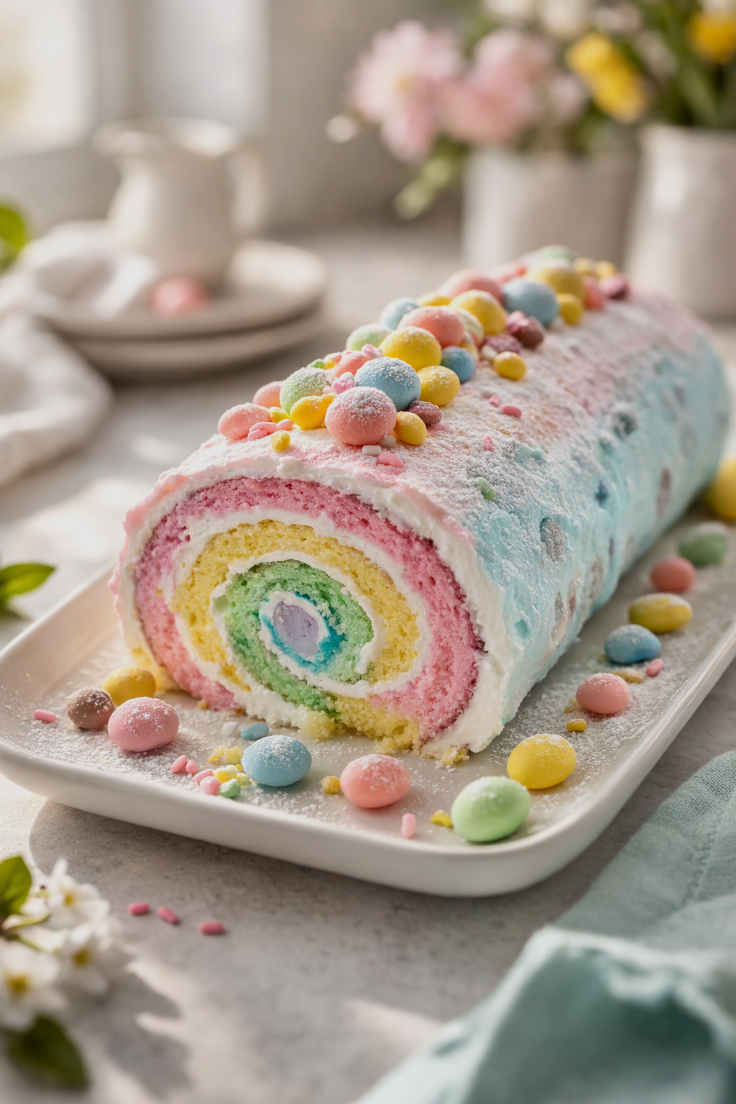

Easter Swiss Rolls with Cream Cheese Filling
Ingredients
Equipment
Method
- Preheat and prep: Preheat oven to 350°F (175°C). Spray a 10×15-inch jelly roll pan, line with parchment, and spray parchment lightly.
- Beat egg whites: In a large bowl, beat egg whites, lemon juice, and salt on medium-high until foamy. Gradually add sugar and beat until soft peaks form.
- Fold in flour: Sift cake flour over the egg whites. Gently fold with a rubber spatula until just combined. Do not overmix.
- Divide and color: Divide batter evenly into three bowls. Add a different gel food color to each bowl and fold gently until uniform.
- Swirl and spread: Drop spoonful of each colored batter randomly into the prepared pan. Use a knife or skewer to gently swirl colors together. Spread into an even layer.
- Bake: Bake for 12 minutes, until cake springs back when touched.
- First roll: Immediately flip cake onto a clean towel or parchment dusted with powdered sugar. Peel off baked parchment. Starting at a short end, roll cake up with the towel inside. Cool completely on a wire rack.
- Make filling: In a medium bowl, beat cream cheese, heavy cream, sugar, and vanilla until medium-stiff peaks form. Fold in crushed candies.
- Unroll and fill: Gently unroll cooled cake. Spread filling evenly over cake, leaving a small border around edges.
- Re-roll: Roll cake back up tightly, without the towel inside. Wrap in plastic and chill for at least 30 minutes.
- Decorate and serve: Dust with powdered sugar and top with extra crushed candies before slicing and serving.
Notes
- Room temperature egg whites whip to a higher volume. Separate eggs when cold, then let whites sit for 20-30 minutes before beating.
- Do not overbake! A dry cake will crack. Bake for exactly 12 minutes.
- Roll immediately while the cake is hot. This trains it to hold the shape.
- Cool completely before filling, or the filling will melt.
- Whip filling to stiff peaks so it holds its shape in the roll.
- Chill before slicing for clean, beautiful slices. Wipe the knife clean between cuts.
- Storage: Store wrapped in the refrigerator for up to 3 days.

Little Bites of Spring
I started this story talking about how spring unrolls itself, slowly revealing color after color.
And that is what this cake feels like to me. A little bit of patience, a gentle hand, and suddenly you have something beautiful where before there was something plain. The egg whites whip into clouds. The colors swirl together like a sunset. The cream filling hides little surprises inside. And when you slice into it, that spiral greets you like a gift.
I do not celebrate Easter, but I do celebrate spring. I celebrate the softness in the air, the return of color, the way the world feels like it is waking up again. And I celebrate it by being in my kitchen, creating something pretty to share with the people I love.
These Easter Swiss Rolls are for anyone who loves spring. For anyone who finds joy in pastel colors and fluffy cake and hidden pockets of chocolate. For anyone who believes that a simple sheet of cake, with a little love and patience, can become something extraordinary.
I hope you make them. I hope you let the colors swirl however they want to. I hope you sneak a few extra crushed candies into the filling. And I hope you share them with people who make your heart feel as light as this cake.
Made these Easter Swiss Rolls? I would LOVE to see your beautiful spirals!
Tag me on Tiktok @thecookiegallery so I can celebrate your spring baking with you.
Love The Recipe?
Digital Baking Bundle keeps everything in one place.
